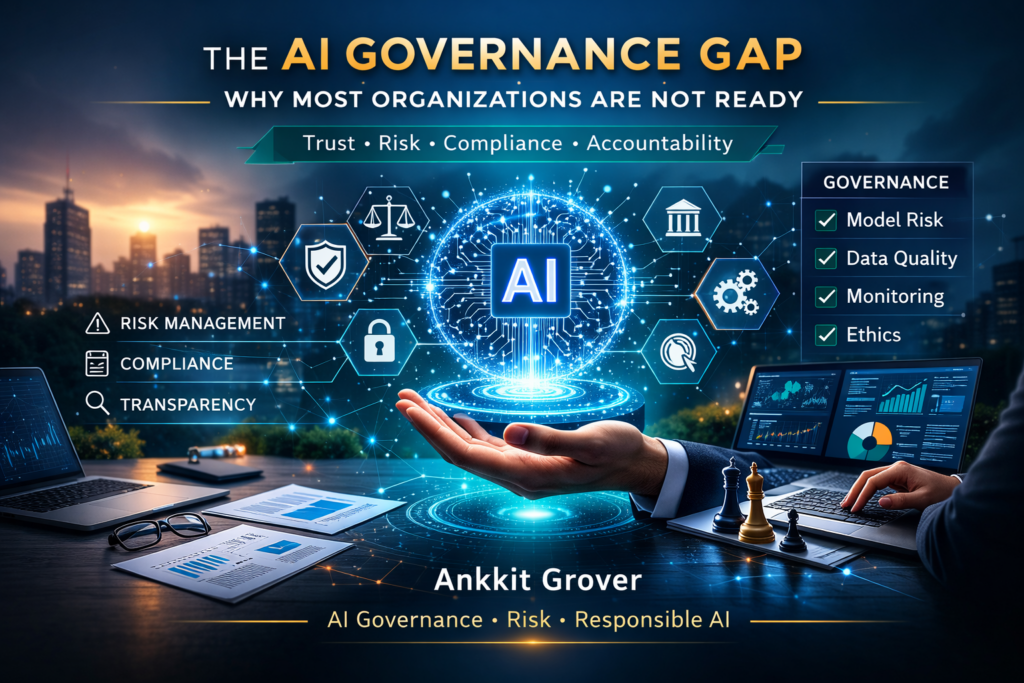
Artificial Intelligence is moving into production environments faster than most organizations can govern it. Over the past few years, AI has shifted from experimentation to becoming embedded in critical business processes—impacting decisions related to risk, operations, customer experience, financial outcomes, and regulatory compliance.
However, while adoption has accelerated rapidly, governance has not kept pace.
Many organizations are deploying AI models without fully understanding how to manage the risks that come with them. This creates a governance gap—one that exposes organizations to operational failures, regulatory scrutiny, model misuse, and erosion of stakeholder trust.
One of the most common misconceptions is that existing IT governance or traditional model risk management frameworks are sufficient for AI systems. In reality, AI systems behave fundamentally differently from traditional deterministic systems. Traditional applications follow fixed rules and produce predictable outputs. AI models, by contrast, learn from data, evolve over time, and may produce different outcomes as data distributions and environmental conditions change.
This adaptive nature introduces new categories of risk that static governance frameworks were never designed to handle.
Another major challenge is ownership. In many organizations, there is no clear answer to a simple question: who owns AI risk? Is it the data science team that builds the model? The business team that uses it? The risk function responsible for oversight? Or IT, which deploys it into production?
Without clearly defined ownership and accountability, governance becomes fragmented. Critical lifecycle activities such as validation, monitoring, performance review, and model retirement may be inconsistently applied—or overlooked entirely.
Monitoring is another area where governance often breaks down. AI models do not remain accurate indefinitely. As real-world conditions evolve, model performance can degrade—a phenomenon known as model drift. Without structured monitoring and performance thresholds, degradation may go undetected, leading to flawed outputs, incorrect decisions, and unintended business consequences.
Transparency presents an additional challenge, particularly with complex or opaque models. Many AI systems function as “black boxes,” where internal decision logic is not easily interpretable. When organizations cannot clearly explain how decisions are made, it introduces governance risk, regulatory exposure, and potential loss of confidence among stakeholders.
Data governance is equally critical. AI systems are only as reliable as the data used to train them. Poor data quality, incomplete lineage, biased datasets, or lack of appropriate controls can result in unreliable or unfair outcomes. Strong governance must ensure that data used in AI systems is traceable, validated, and managed within established control frameworks.
Independent validation is another cornerstone of robust governance, yet it is frequently under-implemented in fast-moving AI environments. Mature risk organizations require independent validation of models prior to deployment. However, pressure to accelerate AI adoption often compresses or bypasses this process, increasing the risk of deploying models with unrecognized weaknesses.
At the same time, regulatory expectations are evolving rapidly. Regulators globally are increasing their focus on AI governance, transparency, and accountability. Organizations that fail to establish structured governance frameworks today may face significant compliance, operational, and reputational risks in the future.
Closing the AI governance gap requires deliberate and structured action. Organizations must establish clear accountability, formalize lifecycle governance controls, implement independent validation processes, and continuously monitor models in production environments.
AI governance is not a one-time activity. It is an ongoing discipline that must evolve alongside technological advancement.
Organizations that invest in governance early will be better positioned to scale AI safely, maintain trust, and ensure sustainable adoption. Those that delay governance may face operational failures, regulatory consequences, and loss of institutional credibility.
The governance gap is real—but it is solvable. With the right governance structures, ownership clarity, and risk management discipline, organizations can unlock the full value of AI while managing its risks responsibly.
—
Written by Ankkit Grover
AI Governance | Risk | Responsible AI | Model Risk Management
Attribution, Sources, and Intellectual Property Notice
This article reflects original analysis, interpretation, and professional perspective based on practical experience and industry understanding of AI Governance, Model Risk Management, and Enterprise Risk Frameworks.
Conceptual alignment and governance principles discussed in this article are informed by widely recognized regulatory and industry standards, including:
- NIST AI Risk Management Framework (AI RMF 1.0)
https://www.nist.gov/itl/ai-risk-management-framework - Federal Reserve Supervisory Guidance on Model Risk Management (SR 11-7)
https://www.federalreserve.gov/frrs/guidance/supervisory-guidance-on-model-risk-management.htm - OECD Principles on Artificial Intelligence
https://oecd.ai/en/ai-principles - EU Artificial Intelligence Act
https://artificialintelligenceact.eu/ - BIS (Bank for International Settlements) Risk Management Principles for Machine Learning
https://www.bis.org/
No copyrighted text has been reproduced verbatim. All content presented in this article is original and intended for educational, informational, and professional knowledge-sharing purposes.
Where governance concepts align with established industry frameworks, they are referenced conceptually and expressed through original interpretation.
Unauthorized reproduction or redistribution of original content without proper attribution is prohibited.
© 2026 Ankkit Grover. All Rights Reserved.