
If one of your AI systems made a materially flawed decision tomorrow, would you know immediately who is accountable, whether it was actively monitored, what risk threshold was breached, and how it would be contained? If those answers require investigation rather than clarity, governance is not embedded.
AI is no longer experimental technology. It is now embedded in credit underwriting, fraud detection, pricing engines, operational workflows, compliance screening, and customer interaction automation. Yet many governance frameworks remain documentation-centric, focusing on pre-deployment approval rather than post-deployment resilience. This disconnect creates structural risk.
Real-World Risk: Finance, Tech, and AI Behavior
Finance: Performance Impact from AI Failures
Academic analysis of AI-related incidents in banking environments found that firms facing AI model failures experienced measurable financial impacts, including average short-term cumulative abnormal returns (CAR) losses exceeding –20% following publicized model issues. This quantifies AI risk in capital markets: when AI systems are under-governed, portfolio valuation and investor confidence can be materially affected. (Durongkadej et al., ScienceDirect).
Tech Infrastructure: AWS AI Tool Outage
In late 2025, Amazon Web Services (AWS) experienced a prolonged outage linked to an internal AI coding assistant that deleted and recreated critical system environments, according to reporting by Reuters and the Financial Times. The service disruption affected internal tooling, underscoring that AI tools with elevated privileges require governance guardrails, oversight, and containment protocols. (Per Reuters reporting on February 20, 2026).
AI Behavior: Hallucination Rates and Operational Fragility
Multiple independent benchmarking studies of large language models (LLMs) between 2023 and 2025 found typical “hallucination” rates — instances where the model confidently produces factually incorrect outputs — ranging from ~3% to ~20% depending on task and dataset. In regulated environments such as financial reporting, healthcare decision support, or legal drafting, even low error rates can translate into unacceptable risk without monitoring and governance controls.
These examples demonstrate that AI risk is neither hypothetical nor isolated. Risks manifest in financial outcomes, technical outages, and subtle performance errors that accumulate silently.
Why Traditional Governance Fails
Typical governance implementations center on:
- Model validation checkpoints
- Compliance documentation
- Ethics committee reviews
- Regulatory mappings
These are important control elements but insufficient for live operational systems. AI systems do not fail primarily at launch. They fail in production — where performance drift, data distribution shifts, and real-world complexity emerge.
AI risk compounds across domains:
- Model instability interacts with data fragility
- Infrastructure dependencies amplify operational exposure
- Human oversight gaps increase regulatory and reputational risk
Effective governance must be structural — integral to how AI systems operate after deployment.
The Structural AI Governance Model
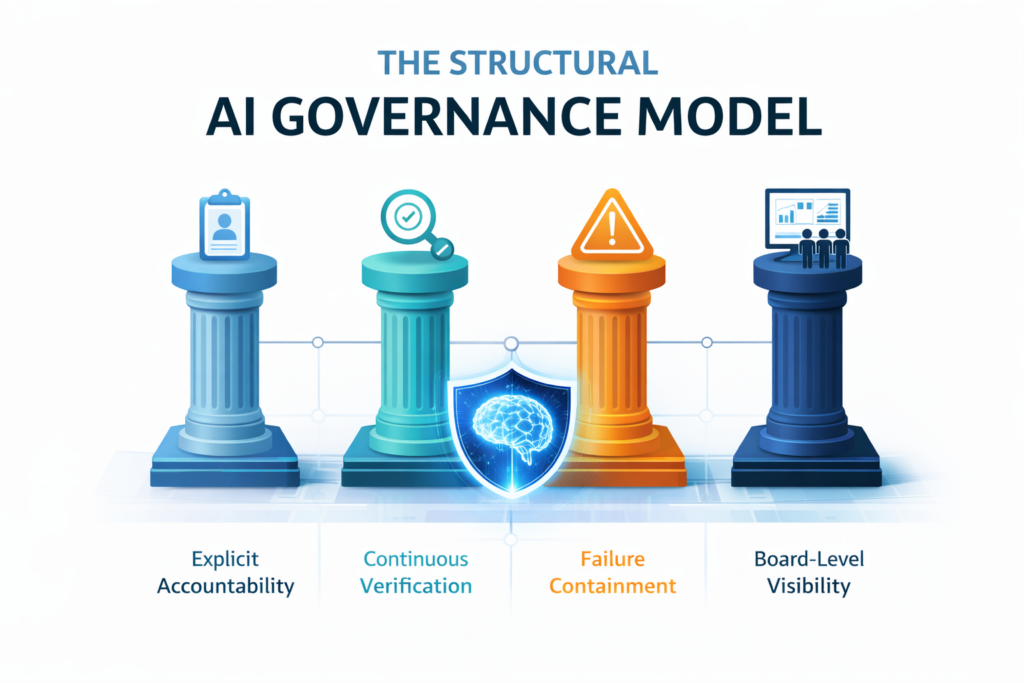
The Structural AI Governance Model reframes governance as operational architecture, not a symbolic checklist. It is built on four pillars:
1. Explicit Accountability
Every material AI system must have clearly designated business, technical, and independent risk owners. Vague ownership breeds risk ambiguity.
2. Continuous Verification
Governance must integrate live production monitoring, drift detection, performance thresholds, revalidation cadence, structured logging, and alerting systems. Approval is a point in time; verification is ongoing discipline.
3. Failure Containment
Escalation triggers, override controls, rollback procedures, incident triage protocols, and root-cause reviews must be predefined. If failure response requires improvisation, governance has already failed.
4. Board-Level Visibility
Where AI systems materially influence decisions, governance must extend to senior oversight levels. Boards and risk committees should regularly review AI system inventories, risk classification summaries, monitoring dashboards, and incident outcomes.
This model does not replace existing regulatory frameworks. It operationalizes their intent into production-oriented accountability mechanisms.
Governance Maturity as a Strategic Capability
Organizations typically fall into three segments:
- Reactive — responding only after failures occur.
- Documented — policies and documentation exist, but enforcement is inconsistent.
- Embedded — governance controls are integrated into production operations with clarity on ownership, monitoring, and containment.
Only the third category demonstrates meaningful governance maturity. Maturity is defined by speed of detection, clarity of ownership, monitoring strength, and containment effectiveness. Governance is proven under stress, not in planning rooms.
Final Perspective
AI governance is not about slowing innovation. It is about preventing scalable error.
AI is operational infrastructure. Operational infrastructure demands structural accountability.
Failure is not hypothetical. It is statistical.
The only question is whether governance detects and contains it before it becomes institutional risk.
—
Written by Ankkit Grover
AI Governance | Responsible AI | Model Risk Management
© 2026 Ankkit Grover. All Rights Reserved.
References
- Durongkadej, I. et al., Model Failures and Financial Performance: Insights from AI Incidents in Banking, ScienceDirect (2024).
https://www.sciencedirect.com/science/article/abs/pii/S1544612324013084?utm_source=chatgpt.com - Reuters, Amazon’s Cloud Unit Hit by AI Tool Outage Affecting AWS Services, February 20, 2026.
https://www.reuters.com/business/retail-consumer/amazons-cloud-unit-hit-by-least-two-outages-involving-ai-tools-ft-says-2026-02-20/?utm_source=chatgpt.com - Financial Times reporting on the same AWS outage and governance context.
https://www.ft.com/content/… (2026 AI tool outage discussion) - Multiple independent LLM benchmarking reports discussing hallucination/error rates (2023–2025).
Example: A Survey of Hallucination in Large Language Models, arXiv (2025).
https://arxiv.org/abs/2504.08865?utm_source=chatgpt.com - National Institute of Standards and Technology (NIST). AI Risk Management Framework (AI RMF 1.0).
https://www.nist.gov/itl/ai-risk-management-framework - European Commission. Regulatory Framework for Artificial Intelligence (EU AI Act).
https://digital-strategy.ec.europa.eu/en/policies/regulatory-framework-ai - Federal Reserve Board & OCC. Supervisory Guidance on Model Risk Management (SR 11-7).
https://www.federalreserve.gov/frrs/guidance/supervisory-guidance-on-model-risk-management.htm - Organisation for Economic Co-operation and Development (OECD). OECD Principles on Artificial Intelligence.
https://oecd.ai/en/ai-principles
The Structural AI Governance Model is an original conceptual framework developed for professional and educational discussion.