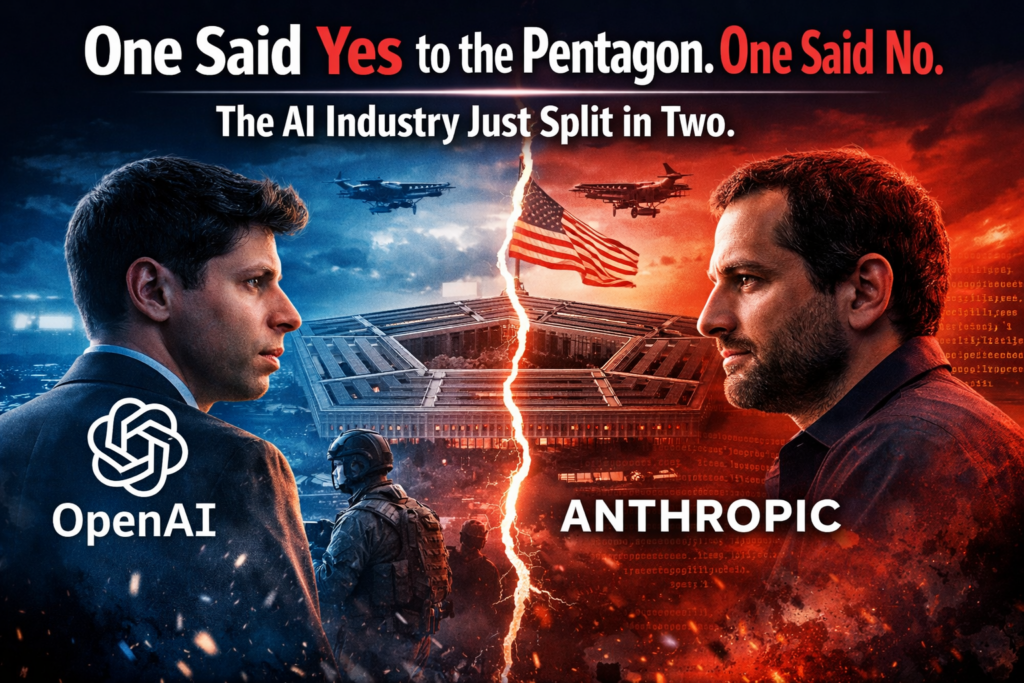
A Decision That Changed the Conversation Around AI
In late February 2026, the artificial-intelligence industry reached a moment that may define its future.
Two leading AI companies received the same signal from the U.S. defense establishment. Yet they responded in completely different ways.
Within days, one company began deploying its models inside military infrastructure. The other refused to loosen safeguards designed to limit military applications.
As a result, the AI industry suddenly found itself confronting a question it had long avoided:
Should advanced AI become part of national defense systems?
The events unfolded quickly, but the implications could shape the future of the technology for years.
The Deal Between OpenAI and the Pentagon
On February 27, 2026, OpenAI confirmed an agreement with the United States Department of Defense to deploy its models on classified government networks.
According to reporting from Reuters, the Pentagon plans to integrate OpenAI systems into secure infrastructure used across defense agencies.
The collaboration focuses on areas such as:
- operational planning
- intelligence analysis
- logistics optimization
- cyber security support
Importantly, OpenAI stated that the agreement includes safety boundaries. The company says its models will not be used for domestic mass surveillance or fully autonomous weapons decisions without human oversight.
However, the deal still represents a major shift.
Until recently, most large AI labs avoided direct military partnerships. Now, one of the world’s most powerful AI developers has decided to engage directly with defense institutions.
Consequently, the decision signals that AI is rapidly becoming part of strategic national infrastructure.
Anthropic Chose a Different Path
While OpenAI moved forward, Anthropic reached the opposite conclusion.
The company refused to remove restrictions that prevent its AI system, Claude, from supporting:
- mass surveillance programs
- fully autonomous weapons systems
Anthropic argued that current AI models remain too unpredictable for those roles. Therefore, the company maintained its safeguards even after negotiations with the Pentagon intensified.
The disagreement escalated quickly.
Soon afterward, the U.S. Department of Defense labeled Anthropic a “supply chain risk.”
According to Reuters and the Associated Press, that designation effectively blocks the company’s systems from government defense networks and contracts.
Anthropic has since challenged the decision in court. The company argues that the designation could cost hundreds of millions or even billions of dollars in lost business.
Meanwhile, Pentagon officials stated publicly that negotiations with the company will not resume.
Why the Industry Is Watching Closely
This conflict matters for one simple reason: artificial intelligence has moved beyond consumer applications.
Governments now view AI as critical infrastructure, similar to:
- satellites
- cyber security platforms
- semiconductor manufacturing
For example, the U.S. military already operates programs such as Project Maven, which uses machine learning to analyze surveillance imagery and assist intelligence teams.
Generative AI systems could extend those capabilities dramatically. They could summarize intelligence reports, accelerate operational planning, and automate large analytical workloads.
As a result, defense agencies across the world have begun actively pursuing partnerships with leading AI companies.
However, the recent divide between OpenAI and Anthropic reveals that the industry has not reached a consensus about how far those partnerships should go.
Two Philosophies Are Emerging
The contrast between OpenAI and Anthropic reflects two very different strategic philosophies.
OpenAI believes responsible companies should engage with governments. From that perspective, participation allows companies to influence how AI systems are deployed and governed.
Anthropic takes a different view. The company believes certain applications — particularly autonomous weapons and mass surveillance — require strict boundaries.
Both positions reflect legitimate concerns.
On one hand, governments argue they need advanced technology to address national-security threats. On the other hand, AI researchers warn that premature military integration could introduce serious risks.
Therefore, the disagreement is not simply about one contract. Instead, it represents a deeper debate about the future role of AI in society.
A Turning Point for the AI Industry
The most important takeaway from this episode is clear.
AI companies are no longer just building software tools. They are developing technologies that governments view as strategic assets.
Consequently, these companies now face decisions that extend far beyond product design or market competition.
They must decide:
- which institutions they partner with
- where they draw ethical boundaries
- how their technology should influence global power structures
The choices made today could determine how artificial intelligence shapes geopolitics, security, and international competition in the decades ahead.
And in February 2026, two of the most influential AI companies answered that question in completely different ways.
Sources
- Reuters — OpenAI deal to deploy models on U.S. Department of Defense networks (Feb 27, 2026)
- Reuters — Pentagon expanding AI infrastructure across classified networks (Feb 2026)
- Reuters — Anthropic challenges Pentagon “supply chain risk” designation (Mar 2026)
- Reuters — Pentagon CTO says negotiations with Anthropic will not resume (Mar 12, 2026)
- Associated Press — U.S. government labels Anthropic a supply-chain risk (Mar 2026)