A plain note saying “AI helped with this” can cost you trust, even when the work itself is exactly the same. This article looks at the research behind that finding, what two researchers now propose instead of a bare label, and where their proposal is still untested.
Where this comes from
The new piece is “Disclosure without the Social Penalty: A Trust-Preserving Standard for AI Transparency” by Oliver Schilke and Martin Reimann, first published online on October 29, 2026, in Behavioral Science & Policy. It does not report new experiments. It turns the authors’ own earlier research into recommendations for regulators and employers.
Most of that research is in their 2025 paper in Organizational Behavior and Human Decision Processes, “The transparency dilemma: How AI disclosure erodes trust”, which reports 13 experiments. The numbers in this article come from that 2025 paper, as reported in the authors’ accepted manuscript.
What the experiments found
The design was simple. Participants judged work that was otherwise the same. The only difference was whether AI use was disclosed. In the authors’ summary, the tasks included “workplace messages, performance-related evaluations, financial judgments, and organizational communications.” When AI use was disclosed, “participants trusted the person or organization significantly less, even though the quality of the work itself was held constant.”
One example is close to everyday management. In Study 4, 90 people with experience working in law firms read an annual performance review from a supervisor and rated their trust on a 7-point scale. When the review said it had been prepared by generative AI, average trust was 3.80. When it made no such statement, average trust was 5.00.
Across 12 of their 13 experiments, the authors’ within-paper meta-analysis put the average penalty at about 0.8 of a standard deviation (θ = 0.81, 95% confidence interval 0.66 to 0.96). In the new article they call that “a large effect by conventional standards.”
This does not show that people distrust AI. What fell was trust in the human or the organization that said AI was involved.
Softer wording did not fix it
A natural response is to word the disclosure more carefully. The authors tested that in a job application study (Study 9) with six different framings. Every one of them still lowered trust compared with no disclosure. Adding that the letter had been “reviewed and revised by the human sender” made essentially no difference. Average trust was 3.03, against 3.04 for the basic AI disclosure. Saying AI was used only for proofreading was the mildest version, yet trust was still significantly lower than with no disclosure (p = .02).
As the new article puts it, “disclosure wording mattered at the margins, but it did not remove the penalty.”
Hiding it is riskier
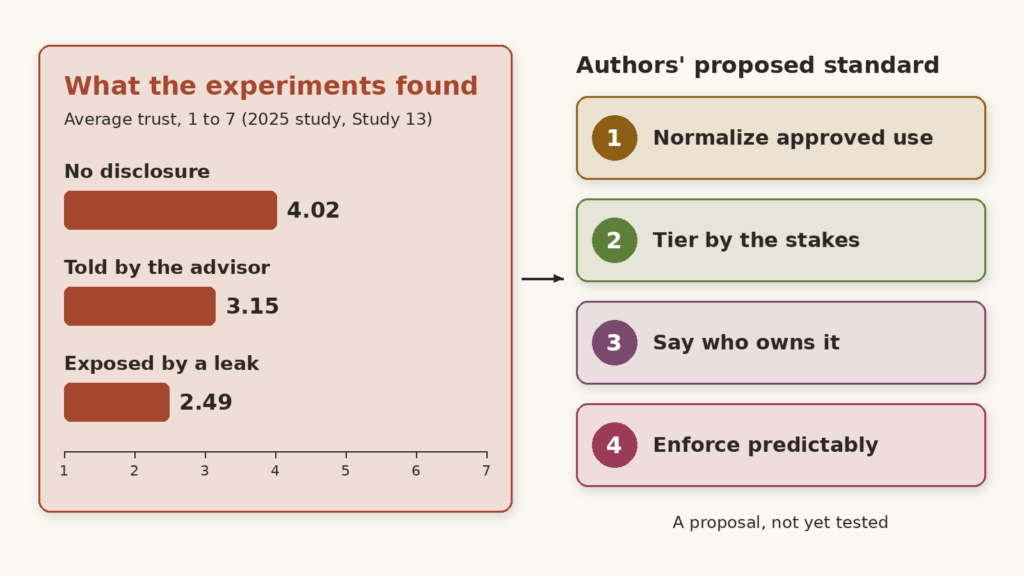
The obvious temptation is to stop disclosing. The research points the other way. In Study 13, 195 people rated a tax advisor who had used generative AI to estimate their tax refund. Some were told by the advisor himself. Some read a news item, citing an anonymous leak, that revealed it. Others saw no disclosure at all. Average trust was 4.02 with no disclosure, 3.15 when he disclosed it himself, and 2.49 when he was exposed.
So staying quiet is not a safe option. The authors describe concealment as something that “could become a high-risk gamble should AI use become easier to detect.” Their key points put the shift plainly: “Policy should shift from whether to disclose to how to disclose.”
The policy trap
This is where the article becomes useful for anyone writing an AI-use policy. If a rule simply requires an “AI was used” label, the people who follow it take the trust hit, while people who ignore it without saying so do not, at least until they are found out. The authors warn that blanket rules “can unintentionally penalize conscientious actors and encourage concealment.”
The proposed standard, in four parts
The authors offer four recommendations. These are their proposals. They have not been tested as a package, and the article does not show that they remove the penalty.
- Normalize approved AI use first. Publish permitted uses and approved tools, and have leaders visibly use them in everyday work. The authors note that these norms “might take time to spread” and “might not show immediate results.”
- Tier disclosure by the stakes. Keep it brief for routine uses, add a short scope note for consequential ones, and require a documented decision trail for high-stakes decisions.
- Pair disclosure with ownership and accountability. Say what the AI did, what the human did, and who owns the result.
- Enforce predictably, and protect honest disclosure. In their words, “Good-faith disclosure of permitted AI use should not itself trigger discipline.”
The tiers are the most practical part. Tier 1 covers routine, low-stakes work such as internal scheduling messages. Tier 2 covers communications that can shape people’s beliefs or evaluations, such as graded feedback or performance evaluations. Tier 3 covers decisions affecting “rights, opportunity, safety, or access,” such as hiring, pay, credit, insurance, housing, and AI-assisted diagnosis or triage. For Tier 3, the authors want a record of the tool, the purpose, the human reviewer of record and the decision process, plus a route for appeal.
The accountability note is meant to move disclosure from a bare label (“AI was used”) to a statement: “Here is what happened and who owns it.”
The authors also apply the standard to themselves. Their article ends with an “Author AI Disclosure Note (Tier 2)”. It says AI tools helped with drafting, revising and copyediting, that they were “not used to generate the manuscript’s ideas, arguments, conclusions, or policy recommendations”, and that the coauthors are accountable.
What the evidence does not show
- The new article contains no new data. The experiments it draws on for the penalty are the authors’ own, and it cites no independent replication of them.
- The experiments mostly captured trust in a first encounter. The authors write that “Most research to date has examined swift trust” and that “Trust penalties may be smaller in long-standing relationships”, while adding that organizations “should not assume that familiarity always eliminates the problem.”
- The four-part standard is a proposal. No study yet shows that tiers or accountability notes reduce the penalty.
- The article does not say that any law or regulator has adopted this standard.
What I would take from it
In my view, if you are writing an AI-use policy, a single required label is the weakest option, because it puts the cost on the people who comply. These are my suggestions, not the authors’ findings:
- Write down which uses are approved before you require anyone to disclose them.
- Match disclosure to the stakes. A meeting summary might need a one-line note, a performance review a scope note, and a hiring or pay decision a full record with an appeal route.
- Use a three-part line that says what the AI did, what the person did, and who is accountable.
- Do not punish honest disclosure of approved use. Put enforcement effort into concealment and skipped review steps.
- Do not read any of this as a reason to stay quiet. In these experiments, being exposed was worse than disclosing.
Transparency still matters. The question this article raises is how to disclose in a way that does not punish the people who are honest about it.
This article reflects the author’s personal views, not those of any employer, and is based on publicly available work by Schilke and Reimann, namely an article in Behavioral Science & Policy and a peer-reviewed study in Organizational Behavior and Human Decision Processes, as available on November 1, 2026. It is not affiliated with or endorsed by the authors or either journal, and quoted findings and opinions are theirs. It is general information, not legal or professional advice, and reading it does not create any advisory relationship. Get qualified advice before acting on how it applies to your organization.