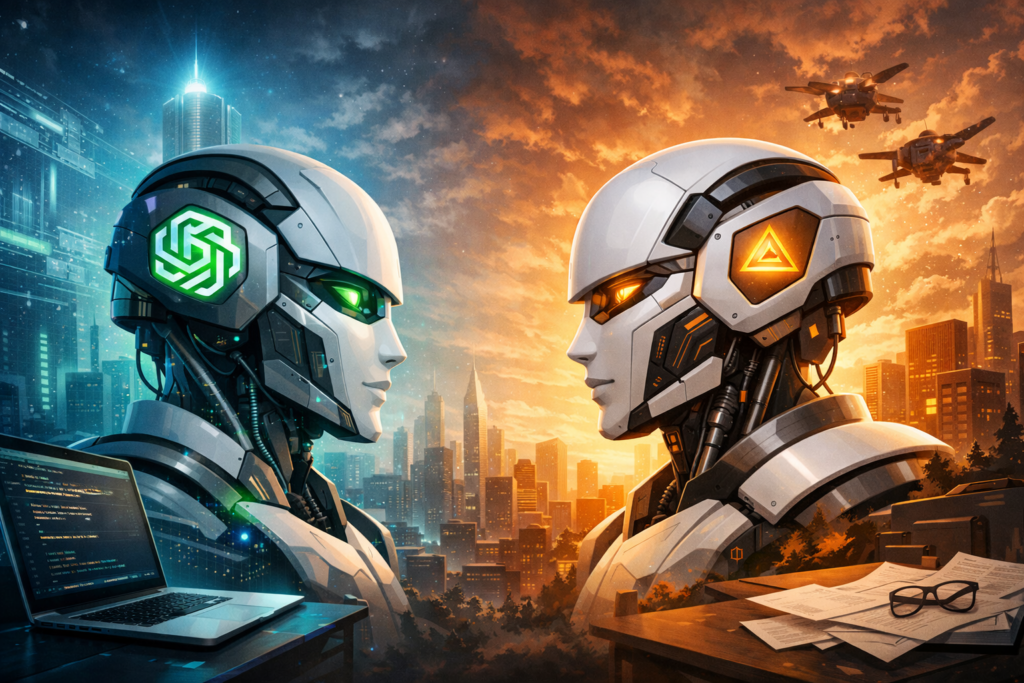
How two frontier AI labs are running radically different governance experiments
Artificial intelligence is often framed as a race for capability.
- Which model scores higher on benchmarks?
- Which company can train the largest system?
- Who will reach artificial general intelligence first?
But beneath the technical race lies a quieter and arguably more important competition: the governance battle shaping the future of AI.
Two organizations sit at the center of this experiment — OpenAI and Anthropic.
Together they represent:
• $30B+ in strategic investment commitments
• AI systems used by hundreds of millions of users globally
• Infrastructure requiring tens of thousands of GPUs
• Models trained on trillions of tokens
These companies are not just building models. They are testing two fundamentally different ways of governing AI.
Why AI Governance Is Becoming a Structural Issue
Artificial intelligence introduces operational risks that behave differently from traditional software systems.
Independent benchmarks have found large language model hallucination rates ranging from roughly 3% to over 20% depending on task type. Frontier models are trained on datasets containing trillions of tokens, and a single training run for a cutting‑edge model can exceed $100 million in compute costs.
Global AI spending is projected to surpass $500 billion annually by 2027 according to IDC.
When AI systems operate at scale, small error rates become operationally significant. For example, if a system processes 10 million automated decisions per day, even a 2% error rate translates into 200,000 incorrect outputs daily.
This scale fundamentally changes the governance conversation.
The OpenAI Model: Mission‑Controlled Commercialization
OpenAI was founded in 2015 with the mission of ensuring artificial general intelligence benefits humanity.
Originally structured as a nonprofit research lab, the organization soon confronted the immense costs of frontier AI development. Training advanced models requires massive GPU clusters and large engineering teams.
In 2019, OpenAI created OpenAI LP — a capped‑profit commercial subsidiary governed by a nonprofit parent organization. The structure allows OpenAI to attract large investments while preserving mission oversight.
Microsoft has committed more than $13 billion in investment and infrastructure support. This partnership integrated OpenAI models into the Azure ecosystem and enterprise products.
OpenAI’s flagship product, ChatGPT, reached 100 million users within two months of launch and later surpassed roughly 180 million monthly users.
In November 2023, the nonprofit board removed CEO Sam Altman, triggering a governance crisis that exposed tensions within the hybrid structure. More than 700 employees signed a letter threatening to resign before the decision was reversed and governance reforms were introduced.
The episode demonstrated the challenge of balancing mission governance with rapid commercialization.
The Anthropic Model: Safety Embedded in Design
Anthropic was founded in 2021 by former OpenAI researchers led by CEO Dario Amodei.
The company focuses heavily on AI alignment and safety research. One of its most prominent contributions is Constitutional AI — a training method where models evaluate outputs using a structured set of guiding principles rather than relying solely on human feedback.
Anthropic operates as a Public Benefit Corporation (PBC), meaning leadership must balance shareholder returns with broader societal impact.
The company has secured major strategic investments:
• Up to $4 billion from Amazon
• Approximately $2 billion from Google
These partnerships provide access to the computing infrastructure required to train frontier AI systems.
Anthropic’s Claude models are increasingly used in enterprise settings such as financial services, healthcare, software development, and customer support.
Rather than separating mission oversight from commercialization, Anthropic attempts to embed safety directly into both its technology and corporate structure.
Two Governance Experiments
OpenAI and Anthropic represent two competing governance philosophies.
OpenAI Model
• Nonprofit board authority
• Commercial subsidiary structure
• Rapid product deployment
• Large ecosystem partnerships
Anthropic Model
• Public Benefit Corporation framework
• Alignment research integrated with development
• Safety‑focused governance philosophy
• More controlled commercialization
Both models remain evolving experiments in governing transformative technology.
Why This Matters for Enterprises
Most organizations will never train frontier AI models, but many will deploy AI systems across business operations.
Industry estimates suggest that around 70% of enterprises will integrate generative AI into core workflows within the next three years.
Enterprise AI systems already process millions of automated decisions daily across sectors such as finance, healthcare, customer service, and software engineering.
At this scale, governance becomes critical. Organizations must address:
• Accountability for AI decisions
• Continuous monitoring of model performance
• Detection of model drift and degradation
• Escalation procedures when systems fail
Governance therefore becomes an operational architecture rather than a documentation exercise.
Conclusion
The future of artificial intelligence will not be defined solely by model capability.
It will also depend on the governance systems that manage these technologies.
OpenAI and Anthropic represent two of the most significant governance experiments underway today. Their structures reflect different theories about how innovation, safety, and commercialization should coexist.
Neither model is final. Both are early prototypes.
The lessons learned from these experiments will likely shape how organizations, regulators, and societies govern AI systems in the decades ahead.
References
1. OpenAI Charter (OpenAI, 2018)
2. OpenAI LP Structure Announcement (2019)
3. Reporting on OpenAI board leadership changes (Reuters, The Verge, 2023)
4. Anthropic Constitutional AI Research Paper (Bai et al., 2022)
5. Anthropic Public Benefit Corporation documentation
6. Microsoft–OpenAI partnership announcements
7. Amazon and Google investments in Anthropic (2023–2024)